
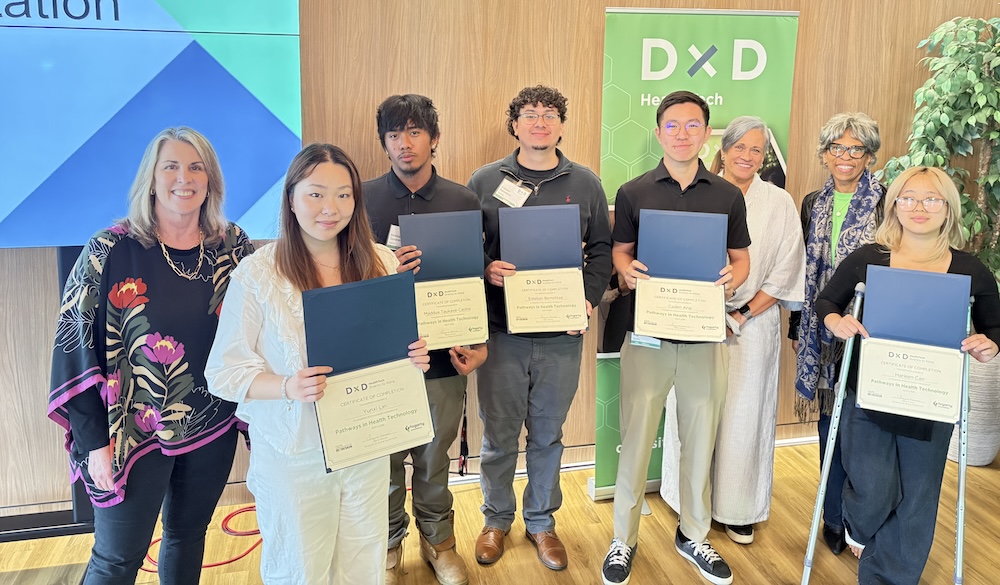
 Lisa Paul is the Chief People Officer at Pulmonx, a global medical device company. Her human resources leadership experience spans more than three decades across health, technology, and communications industries. Since 2022, Lisa has been a frequent volunteer, mentor and advocate for Diversity by Doing Healthtech. With her guidance, Pulmonx has trained community college students in the DxD Pathways in Health Technology program, hired interns from the program, sponsored interns in the Healthtech Exploration Workshop and mentored numerous early career professionals.
Recently, Lisa sat down with DxD Executive Director Ingrid Ellerbe to talk about the why behind her steadfast commitment to training the next generation of diverse healthtech professionals.
IE: Why did you decide to get involved with DxD?
LP: A common theme in healthtech is that it’s about your network and who you know. That’s even true for how Pulmonx got involved with DxD. Our CEO and President, Glen French, heard about DxD through a peer in 2022, and he came to me to ask me what I thought. It sounded like a great opportunity that aligns with our values, allows us to support the community and the next generation of talent in this space.
Because of the significance of networks, it can be hard to get people who are interested in healthtech to get their foot in the door, and working with DxD allows us to open the door a little wider. I’ve been impressed by all the students we’ve met.
IE: What’s been the most rewarding aspect of your volunteer work with DxD?
 LP: I’m at the point in my career where I’m figuring out how to give back in ways that are meaningful and impactful. And I’ve seen the impact of the work we’ve done together with DxD.
The DxD team works so hard to weed through applicants to find the students who are the most committed. One student we met through the Pathways in Health Technology program, who we then brought in as an intern, was working full time and going to school. She was exactly the kind of person we need in our workforce today. Helping students like these gain the skills, gain the confidence, and make their way into healthtech – we’re all in.
IE: As technology and medicine continue evolving, what are the skills or characteristics that consistently lead individuals to long-term success and thriving in the industry?
LP: People skills. The ability to collaborate, communicate, build relationships and manage conflict are the number one keys to success. This is true whether you want longevity in the field or if you want to make a career change: it always comes down to your network, connections and relationships.
The DxD student we hired as an intern is a great example: she made herself memorable by her ability to connect with us.
IE: Mentorship is essential. What advice do you have for finding and maintaining mentor relationships?
LP: You can find mentors everywhere – and it doesn’t have to be a big ask. Sometimes you need a mentor for just one specific thing. For example, when I first started working with Japan, I needed someone with experience with the culture there.
You can’t all do it all by yourself, so you need to know when to ask for help, and have the ability to do so. And how many people ever say no? You should be willing to ask for help, and willing to give help.
IE: What would you like to see in the healthtech industry going forward?
LP: In the healthtech space, we’re purpose-driven – and that’s what makes these companies so exciting. If we had more access, more collaboration, and more partnerships across the industry, it might help us all achieve our purpose. Catheters, for example, get used for many different medical reasons, and I don’t know how well we share the material science, software or hardware across the industry. So leveraging what others are doing, even moving talent around, might help us all improve more patients’ lives.
IE: Why does it remain important to you that the future medtech talent reflect the diversity of the patients they aim to treat?
LP: The data is clear that diverse thinking, diverse experiences, diverse cultures bring better outcomes, better ideas, better experiences. We’ve lost some of that in the rhetoric, but the reality is the research is clear; the experience is real. We do better together.
IE: We really do. And we are so grateful for your support and leadership. Any closing thoughts?
LP: Just that it’s so important that we continue to have programs like this. The mission of bringing opportunities to students and encouraging diversity is more important than ever.