
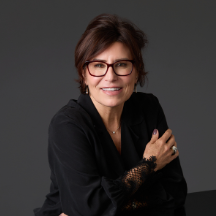
 Susan Willig is a visionary brand and marketing strategist whose career spans industry leaders such as Edwards Lifesciences, Thomson Reuters, LexisNexis, and Gateway Computer. She founded TrueNorth advisory in 2022 to provide strategy and expertise to innovative health technology companies at pivotal moments in their growth trajectory. Susan is passionate about women’s health, health equity and access, volunteering her time and expertise with a number of nonprofits and boards. She is an engaged champion of DxD Healthtech, regularly speaking at events and providing mentorship to students and early-career professionals.
Susan recently spent time with DxD Executive Director Ingrid Ellerbe discussing the importance of helping people find their true north and her commitment to advancing health equity.
IE: You often talk about the importance of finding one’s “true north.” How did you find your “true north,” and what advice would you offer young people to help find theirs?
SW: I tap into structure when I’ve been trying to find my true north at key moments in my career and in my life. The frameworks that have served me well are pros and cons; keeping track of that which gives me energy and that which detracts energy; looking for themes and being honest about themes.
I’m still a believer in the StrengthsFinder, and the importance of building on our strengths and finding an ecosystem of friends, colleagues and family to who can fill in gaps, rather than trying to fill your own gaps.
Another powerful one: articulating a perfect day. Where do I wake up? What do I want to see? What am I feeling? Is there fresh air or am I in a city? Being honest with myself about what’s important to me, rather than trying to put myself into a box in which I don’t fit.
So I triangulate all that info to articulate a true north. What’s as powerful for any brand and living and projecting ones true north is saying “no” to things as well as saying “yes.” I’m a big believer in increasing surface area, but only in those things that will contribute to reaching my true north.
IE: That’s very powerful. You care so much about innovation, health equity, health access, women’s health, heart health – and they all overlap, but are each strong on their own. When did you get to the point in your career where you knew what matters to you on a deeper level?
SW: I was in tech before, and when I entered healthcare, I asked myself what I want to be investing my time, energy and money in. What do I want to be building as a human, regardless of whether it’s a pebble or a boulder that I’m putting into the water? Healthcare was one. But after being in healthcare, I couldn’t believe my ignorance or naivete. I started learning that women weren’t represented in studies, and I was working on projects where we sought to reach audiences and we were doing so ineffectively because we were using channels and tactics meant for a different population. I realized it requires purposeful effort to change things.
I also started looking around and saw homogeneity in leadership and my takeaway was that it contributes to lack of innovation.
So what could I do as an individual, in my role? I can help women and diverse populations succeed in their businesses, which will change the leadership ecosystem, which will create more innovation. I can take what I’ve learned in 30-plus years in startups, technology and med device companies, advisory organizations, and I can contribute my voice, my expertise, my experience to helping them succeed. I’m more grassroots than top-down.
IE: You can’t get any more grassroots than the support you’ve provided for DxD. Have you experienced anything out of your participation with DxD that has encouraged you, or shown that you’re going in the right direction?
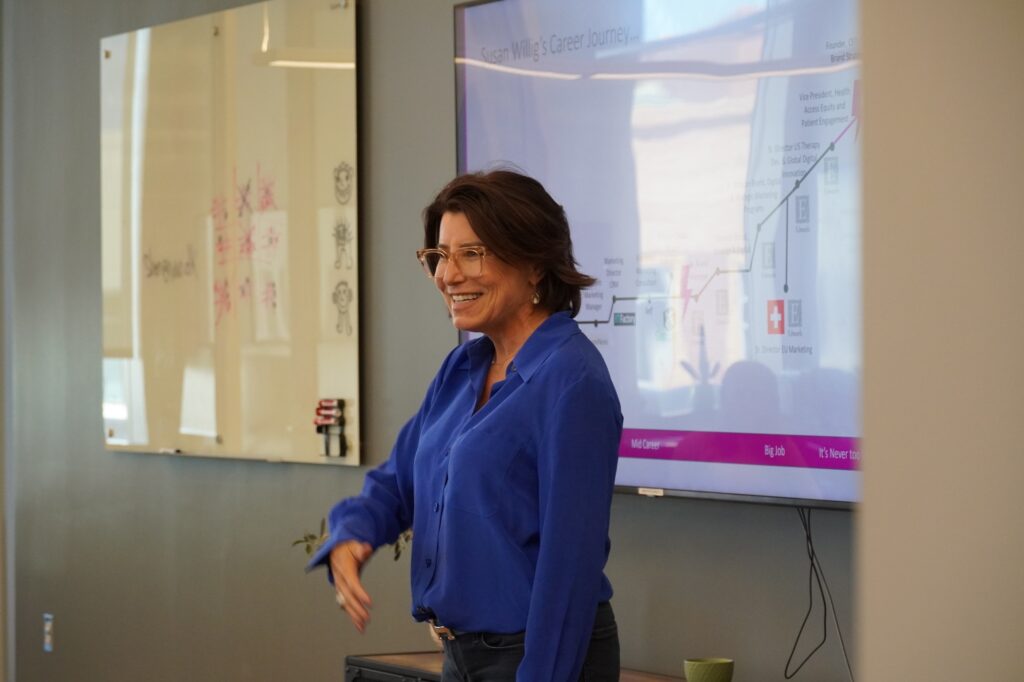 SW: Several of the participants after the Healthtech Exploration Workshop this summer came up to me and said the talk resonated with them. If I can leave you more confident to be yourself, clearer on your brand and your own true north, that’s worth it.
You never know where someone is on their journey. During the sessions, we had been talking about what we are and aren’t allowed to wear in business, and a student came up to me afterward and said it made them feel more comfortable dressed as they were that day. That meant a lot to me. There are norms that constrain self-expression or a sense of belonging, but this student felt more like they belonged after the talk, which was really beautiful.
IE: As we bring in new cohorts of students and create connections to the healthtech industry with them, we know that mentorship is incredibly important to their retention. Is there a favorite piece of advice you share as a mentor?
SW: Show up. The first time you invited me to speak at DxD, I was a little anxious. But my responsibility and my opportunity is to show up, and I’m so glad I did.
Also, I don’t believe in accidents. Someone I know recently invited me to speak on a panel for public health and I wasn’t available. But I had just met someone at a networking event who is passionate about public health and just stepping out in her business. So, I connected them, and now she’s going to speak on that panel. That is not an accident. Another perspective I try to take is “abundance.” I know if I pass something on to someone else, maybe they’re more appropriate than I am for a particular invitation, I remind myself there’s abundance. I don’t need to diminish them to ensure my own success.
Another piece of info I wish I’d known earlier is that you don’t have to go into every meeting room “bulletproof.” I even said this to a client recently: We bring brand strategy expertise into a room with clinical leaders, we’re never going to know all that they know. There are probably going to be things they point out that we missed, but I feel competent in us bringing our expertise. I don’t feel like I have to be bulletproof on every topic anymore. My job is to show up, bring my expertise, and we will have dialogue with people who have other expertise. Ultimately, each person “playing their position” and sharing their voice ensure a robust, more successful outcome. This is pretty well documented in science.
IE: Personal branding is the topic you speak about to interns in DxD’s Healthtech Exploration Workshop. A lot of times students think the most important thing is their academic record or their letter of rec. Why is personal branding so important?
SW: We have such a busy society today. So much is coming at everyone. Personal branding makes it easier for the people whom you want to remember you to actually remember you.
If you introduce yourself by saying, “I’m a third-year major in _____,” how will they remember you? There will be 20 other third-years who all have amazing credentials, so it’s about packaging it in a way that’s exceptional and true. Make it memorable, resonant.
A young man I worked with after the Healthtech Exploration Workshop had a résumé — wow, was it impressive. But then he got to his personal story, and there it was — the umbrella that’s going to hold where he was in that moment and what he is trying to achieve. And to help his exceptionality shine. That’s personal branding.
Plus, personal branding helps you hone your true self. At its best, brand is true self to true self. I show up. You show up. We see each other because we’re not hiding anything and that’s a beautiful connection that’s sustaining.
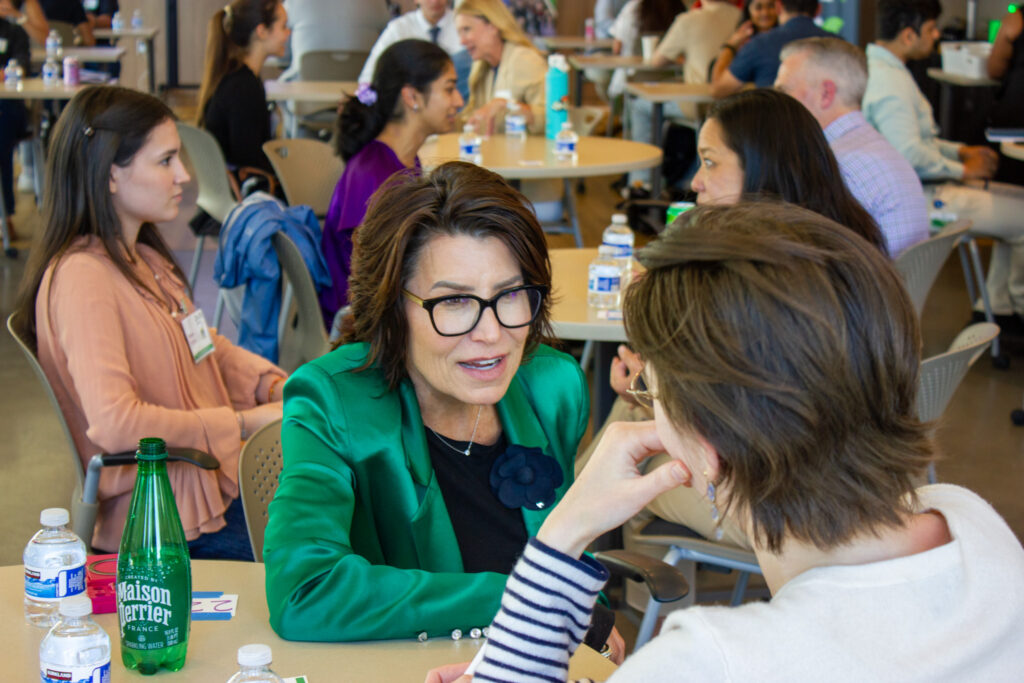 IE: The fact that you spend time with DxD students afterwards to really work with them on their personal branding is really above and beyond. What drives you to do that?
SW: It’s very energizing. I fell in love with brand strategy at 18 when I read the book Positioning. From a selfish place, I think goodness gracious, these are the people who are going to change the world tomorrow. I am not unwise — I want to hear from them, learn from them. It’s just smart to stay in touch with these young minds who are going to be making an impact and changing the world.
IE: Every time we host an event, I learn something about youth and youth culture. What gives you hope about the future of health technology, and what role do you hope the next generation will play in it?
SW: This next generation has far fewer mental barriers than past generations. If they see a gap they aren’t going to expect someone to fill it — they are going to find a way to fill it. They’re going to speak, build, change. To use the phrase: They’ll be the change they want to see.
I love the speed mentoring DxD does, and meeting and spending time with different people. AND I also think of all the people who are also trying to change the world but don’t get to sit in that room.
IE: I know your work is helping them change the world. Your support is life-changing for students, and life-changing for us. Thank you.
To learn more about volunteering with DxD, click here.